
Monsoon Power Surges and Your Compressor: Post-Storm HVAC Checklist
Monsoon lightning and the grid blinks that follow are a leading cause of dead compressors and blown capacitors in Apache Junction. Here is the post-storm checklist that tells you whether your AC survived.
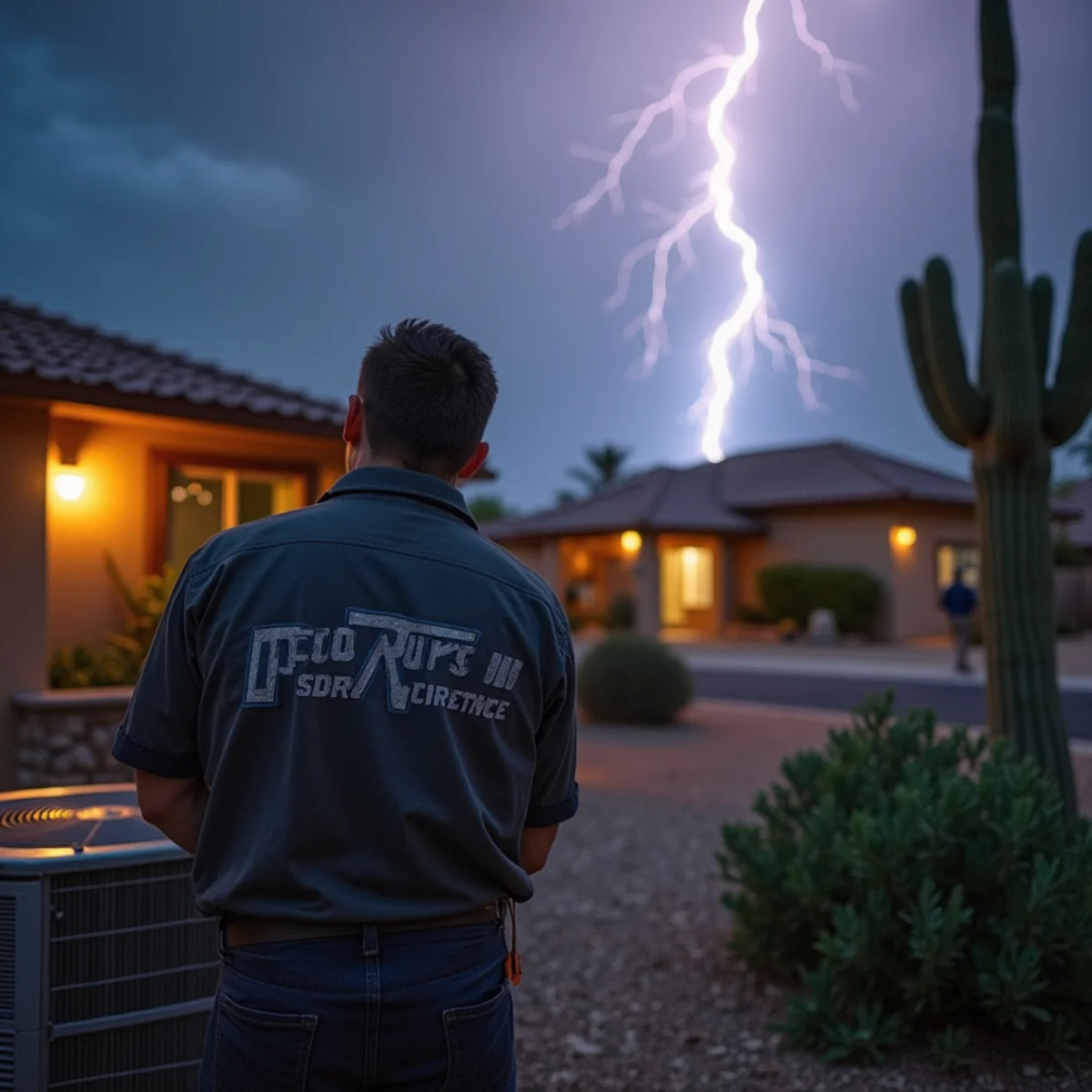
Monsoon storms bring Apache Junction two things at once: a wall of wind and dust, and a very unstable power grid. Lightning strikes, downed lines, and the rapid on-off flickers utilities use to protect the system all send voltage spikes and brownouts down the wire to your home. Your air conditioner, with its big motor loads and sensitive control board, is one of the most vulnerable appliances in the house. Every summer we replace compressors, capacitors, contactors, and control boards that were perfectly healthy until a storm rolled through.
The tricky part is that surge damage does not always announce itself. Sometimes the AC just will not start after the storm. Other times it seems fine for a day, then quits on the next hot afternoon. This checklist walks you through what to look for, what is safe to check, and when to make the call.
How a Surge Actually Hurts Your AC
A power surge is a brief spike of voltage far above the 240 volts your AC expects. A brownout is the opposite, a sag that leaves motors struggling to run on too little. Both are hard on the same components, and the compressor is usually the biggest casualty.
- The run capacitor, a small can that gives the motors their starting kick, is often the first to blow. It is also the cheapest to replace.
- The contactor, an electrical switch that carries the load, can weld shut or pit so it no longer makes clean contact.
- The control board on modern systems can lose its programming or fry outright.
- The compressor motor windings can short, which is the failure nobody wants because the compressor is the most expensive single part.
- Low-voltage from a brownout can cause a motor to stall and overheat while it tries to start.
Your Post-Storm Checklist
Once the storm has passed and it is safe to be outside, work through these steps. None of them require opening a panel or touching wiring.
- Wait a few minutes after power returns before doing anything. Utilities sometimes restore power in stages with more blinks.
- At the thermostat, set the system to Off, then check that its screen and batteries are alive.
- Find the AC breaker in your panel. If it tripped, reset it one time. If it trips again, stop and call.
- Set the thermostat to Cool and listen. A healthy start is a click, the outdoor fan spinning up, and cool air within a minute or two.
- If the outdoor fan hums but will not spin, or the unit clicks and does nothing, shut it off. That is the classic signature of a blown capacitor or welded contactor.
- Photograph any scorch marks, tripped breakers, or error codes on the thermostat for the technician.
Signs the Compressor Took the Hit
If the small parts check out but the system still will not cool, the surge may have reached the compressor itself. Warning signs include a loud hum or buzz from the outdoor unit with no cooling, the breaker tripping the instant the compressor tries to start, or a burning smell near the unit. These point to a locked-up or electrically shorted compressor, which needs a professional diagnosis and, often, a serious repair-versus-replace conversation.
| What you observe | Likely surge damage | Cost tier |
|---|---|---|
| Fan hums, will not spin | Blown run capacitor | Low |
| Clicks, nothing happens | Welded or pitted contactor | Low to moderate |
| Thermostat dead or scrambled | Fried control board or thermostat | Moderate |
| Breaker trips on compressor start | Shorted compressor windings | High |
| Loud buzz, no cooling | Locked compressor | High |
When to Call and How to Prevent the Next One
Any time the breaker will not hold, you smell burning, or the unit hums without cooling, that is a same-day service call, not a wait-and-see. Our monsoon and storm HVAC repair team carries the capacitors, contactors, and boards that storms kill, so most surge repairs are handled on the first visit. We serve all of Apache Junction and Pinal County same-day, and around the clock when the heat is dangerous.
Prevention is straightforward and worth it. A hard-start kit, a whole-home surge protector at the panel, and a dedicated surge device at the AC disconnect all cut the odds that the next lightning storm ends with a dead compressor. Ask us to add one during your next service. For the price of a nice dinner, you protect the most expensive appliance in your house from a grid you cannot control.
Do Not Gamble With the Compressor
A compressor replacement can run into the thousands, so the small parts that protect it are cheap by comparison. After every big monsoon storm, run the checklist, and if anything looks off, call us before the next 110-degree day forces the issue. Reach HVAC Apache Junction AZ at +1 (327) 210-5999, and we will tell you honestly whether it is a quick capacitor swap or something bigger.
Frequently Asked Questions
Yes. A large voltage spike from lightning or a grid fault can short the compressor windings, and repeated brownouts can stall and overheat the motor. The compressor is the most expensive part in the system, which is why surge protection is worth adding.
Confirm the thermostat is alive and set to Cool, then reset the AC breaker one time. If the outdoor fan hums but will not spin, that usually means a blown capacitor. Shut it off and call rather than forcing it to run.
For a monsoon-prone area like ours, yes. A panel-level surge protector plus a device at the AC disconnect costs a fraction of a compressor and meaningfully lowers the risk of storm-related electrical damage.
Very possibly. Surge damage to a capacitor or contactor can leave a system limping until the next hot afternoon pushes it over the edge. If it failed within a day or two of a storm, treat the storm as the likely cause.
Talk to a Local Apache Junction Technician
Same-day across Apache Junction & Gold Canyon — 24/7 in triple-digit heat.
Call +1 (327) 210-5999