
Capacitor Failure After a Monsoon Storm: AJ's Most Common Breakdown
The single most common AC failure we fix in Apache Junction is a blown capacitor. Here is how to spot it, why our heat and monsoon storms cause it, and why it is one of the cheaper fixes if you catch it fast.
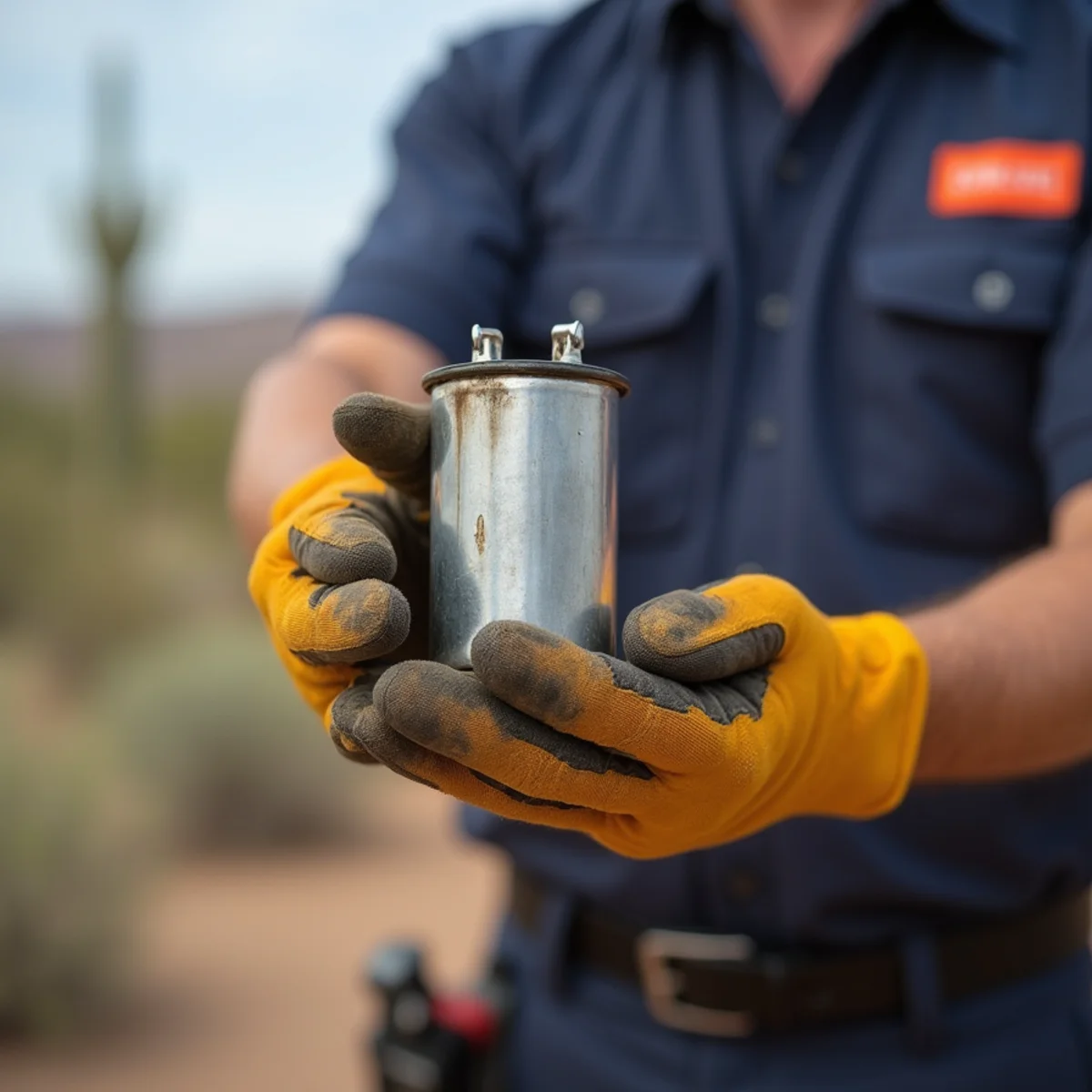
If we had to name the one part that fails more than any other on Apache Junction air conditioners, it would not be close: the run capacitor wins by a mile. It is a small metal can, usually about the size of a soda can, tucked inside the outdoor unit, and its whole job is to give the fan motor and compressor the electrical kick they need to start and keep spinning. When it weakens or dies, your AC either will not start, hums without cooling, or trips out. The good news is that it is one of the least expensive repairs in the whole system, if you catch it before it drags the compressor down with it.
Here is why this little part fails so often in our climate, how to recognize the symptoms, and what to do the moment you suspect one is going.
Why Capacitors Die So Often Here
Capacitors are heat-sensitive by nature, and Apache Junction is about the harshest environment you can put one in. Two things gang up on them: relentless triple-digit heat and an unstable monsoon-season power grid.
- Extreme heat: a capacitor sitting in a metal box in 110-degree sun bakes all day. Heat is the number one thing that shortens capacitor life, and ours never gets a break in summer.
- Long run times: when it is that hot, the AC runs nearly nonstop, so the capacitor is working far more hours than one in a milder climate.
- Power surges: monsoon lightning and grid blinks send voltage spikes that blow capacitors outright, which is why we see a wave of these calls after every storm.
- Age: even a healthy capacitor is a wear item. Most last several years, but our conditions push them toward the short end of that range.
Symptoms of a Failing Capacitor
A capacitor rarely fails silently. Learn these signs and you can catch it before it cascades into a bigger problem.
- The outdoor fan will not spin, but you hear a hum from the unit. This is the classic tell.
- The AC takes several tries to start, or you hear a clicking or humming before it kicks on.
- The unit starts, runs briefly, then shuts off and tries again, called short cycling.
- Warm air from the vents even though the system seems to be trying to run.
- A visible bulge, dome, or leaked oily residue on top of the capacitor can, if you can see it without opening anything.
- A higher electric bill from a compressor straining to run on a weak capacitor.
Why Fast Action Saves You Money
Here is the part homeowners do not always realize: a weak capacitor does not just risk a no-cool day, it actively harms the compressor. When the capacitor cannot deliver a clean starting jolt, the compressor strains, overheats, and draws high current every time it tries to run. Run a compressor like that for weeks and you can turn a cheap capacitor swap into a compressor replacement that costs many times more. Catching the symptom early is the difference between a quick, affordable visit and a major repair.
| What you notice | What it means | Urgency |
|---|---|---|
| Fan hums, will not spin | Capacitor likely dead | Same-day, do not keep running it |
| Hard or delayed starting | Capacitor weakening | Service soon |
| Short cycling | Weak capacitor or related fault | Service soon |
| Bulging or leaking can | Capacitor failed | Shut off, call now |
| Warm air plus humming | Compressor straining | Same-day, protect the compressor |
Getting It Fixed Right
A capacitor replacement is one of the most straightforward jobs we do, and we carry the common sizes on every truck, so most of these are handled on the first visit. When we swap one, we do not just drop in a part and leave. We check the capacitor's rating against the manufacturer's spec, test the contactor and the motors it feeds, and verify the compressor is drawing normal current, because a capacitor that failed early is sometimes a symptom of a bigger issue. Our Apache Junction AC repair team does that full check so you are not calling us back in three weeks.
We see a heavy run of these calls in the older, established neighborhoods where systems have some age on them. Homes around Royal Palm and the surrounding central Apache Junction blocks tend to have units that have weathered plenty of summers, and their capacitors are often first in line to go. If your AC there is showing any of the signs above, do not wait for it to leave you without cooling on a 110-degree day.
One more thing to rule out: if your AC is running constantly but the capacitor tests fine, the problem may be elsewhere. Our guide on why your AC runs nonstop when it is 105°F-plus walks through the other culprits, from low refrigerant to an undersized system.
Catch It Early, Call Us
A blown capacitor is Apache Junction's most common breakdown, and also one of its most preventable disasters, as long as you act on the early signs instead of running the system into the ground. If your fan is not spinning, your unit is humming, or the house is warm while the AC hums along, shut it off and call. We answer 24/7 during heat season and fix most of these on the spot. Reach HVAC Apache Junction AZ at +1 (327) 210-5999.
Frequently Asked Questions
The classic capacitor sign is an outdoor fan that hums but will not spin, or a unit that struggles to start. A technician can confirm it in minutes with a meter. Never open the unit to check yourself; capacitors hold a dangerous charge.
Our extreme heat bakes them, our long summer run times work them nearly nonstop, and monsoon power surges blow them outright. That combination makes the capacitor the single most common part we replace on local air conditioners.
It is one of the more affordable AC repairs, especially compared to a compressor. The catch is that running the system on a weak capacitor can damage the compressor, so catching it early is what keeps it a small bill.
We strongly advise against it. Capacitors store a charge that can cause a serious or fatal shock even with the power off, and matching the correct rating matters. This is a quick, low-cost job for a trained technician and a real hazard for a homeowner.
Talk to a Local Apache Junction Technician
Same-day across Apache Junction & Gold Canyon — 24/7 in triple-digit heat.
Call +1 (327) 210-5999