
AC Repair or Replace? An Honest Framework for Apache Junction Homeowners
Repairing a dying AC in the desert can be throwing good money after bad, and replacing a fixable one is a waste. Here is an honest, number-driven framework for deciding which is which.
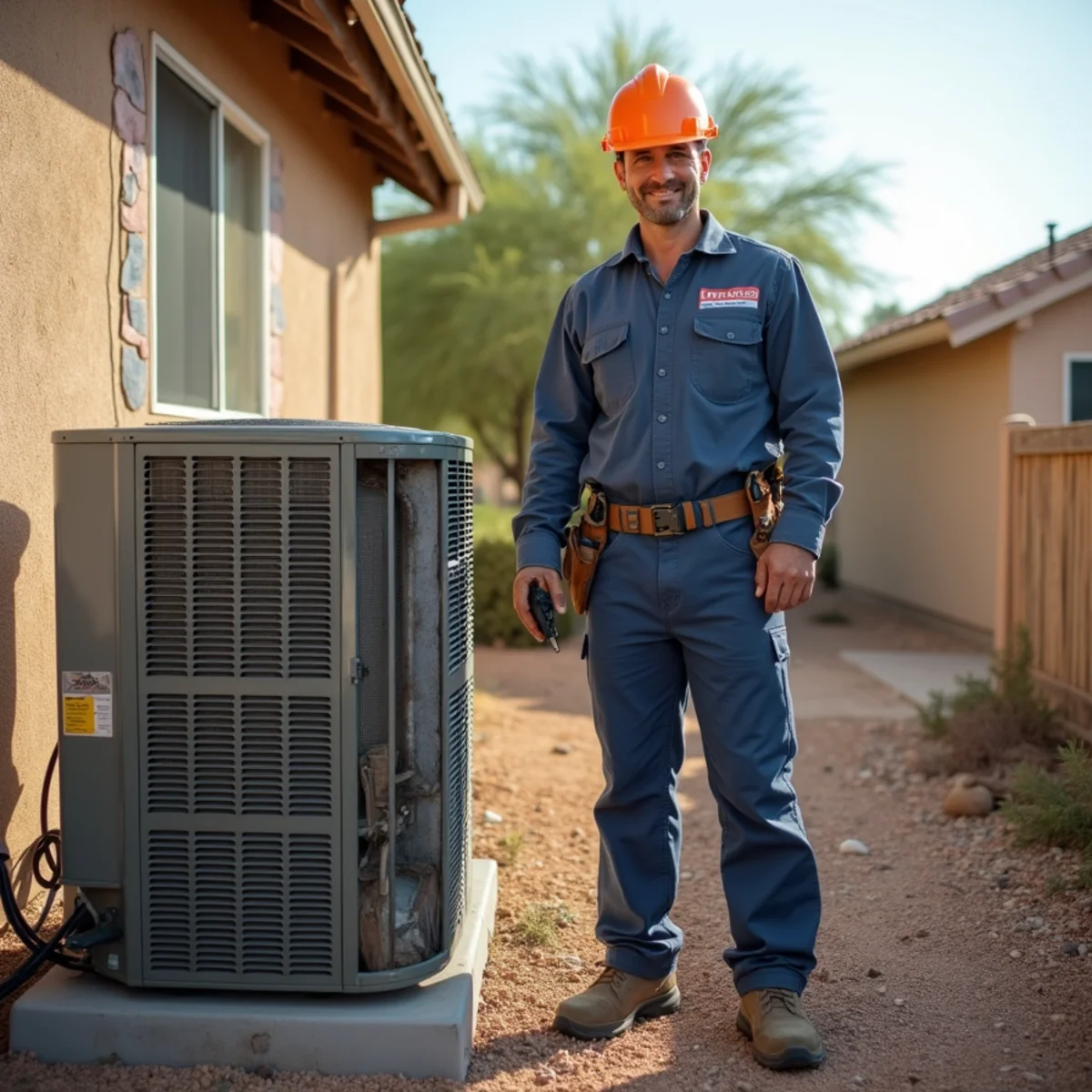
The short answer: repair your air conditioner when it is under about 10 years old, still uses R-410A, and the fix costs less than a third of a new system. Lean toward replacement when the unit is 12-plus years old, uses R-22, has needed repeated repairs, or is facing a major component like a compressor or coil. Everything else is a judgment call, and this guide gives you the exact numbers and local factors to make it honestly, without a salesperson leaning on the scale.
Here in Apache Junction, the decision is harder than the national advice makes it sound. Our air conditioners run four to five months straight against 110-plus-degree afternoons, so they wear out faster and fail at the worst possible moment. Below is the framework our technicians actually use on a service call, so you can follow the same logic before you ever pick up the phone.
Start With the Age of the System
Age is the first filter because it drives everything else, warranty status, refrigerant type, efficiency, and the odds of the next failure. A desert AC simply does not last as long as one in a mild climate. Where a unit in San Diego might see 18 years, the same equipment in Pinal County typically gives 12 to 15 because of relentless run-hours, dust, and heat. If your system is on the older end of that window, every repair dollar buys you less remaining life.
- Under 8 years: Almost always repair. The system has plenty of life left and is likely still partly under warranty.
- 8 to 12 years: The gray zone. Weigh the repair cost against the factors below before deciding.
- 12 years and older: Replacement is usually the smarter long-term play, especially for a major repair. Read our deep dive on how long an AC lasts in Arizona to see where yours falls.
The R-22 Dealbreaker
If your system uses R-22 refrigerant, replacement moves to the front of the line. Production and import of R-22 was banned in the United States in 2020, so the only supply left is reclaimed, and the price has climbed to the point where a single R-22 recharge on a leaking system can cost more than a car payment. Fixing a leak and recharging an R-22 unit is often pouring expensive refrigerant into a system that will need it again next summer.
Any air conditioner manufactured before roughly 2010 may still be running R-22. A technician can confirm it from the nameplate in minutes. If yours is an R-22 system and it has a refrigerant leak, that one fact usually settles the repair-or-replace question on its own. Newer systems use R-410A, and the industry is now transitioning again to lower-impact refrigerants like R-454B, which is worth knowing but not a reason to replace a healthy R-410A unit early.
The 30 Percent Rule and the Cost-of-Life Math
The classic rule of thumb is to replace rather than repair when a single repair costs more than a third of a new system. A full AC or heat pump replacement in our area generally runs $7,000 to $11,500 depending on size, efficiency, and ductwork, so a third lands somewhere around $2,300 to $3,800. A smarter version of the rule multiplies the repair cost by the unit's age: if that number exceeds the cost of replacement, replace.
| Repair | Typical weight in the decision | When it tips toward replace |
|---|---|---|
| Capacitor or contactor | Minor, almost always repair | Rarely, unless paired with other failures |
| Fan motor | Moderate repair | If unit is 12+ years and R-22 |
| Refrigerant leak and recharge | Significant | On any R-22 system, or a repeat leak |
| Evaporator or condenser coil | Major | On a system past 10 years |
| Compressor | Most expensive repair | On almost any system past 8-10 years |
When the diagnosis is a failed compressor on a 12-year-old unit, the math is rarely close. You would be spending a large share of replacement cost to revive the single part most likely to be followed by the next failure. For a transparent breakdown of what individual fixes run locally, see our guide to AC repair costs in Apache Junction.
Recurring Failures and the Efficiency Penalty
Two system-level signals matter as much as any single part. First, recurring failures: if you have called for service two or more times in the last couple of summers, the system is telling you it is near the end. Desert heat exposes every weak link in sequence, and chasing them one at a time gets expensive fast. Second, efficiency: an aging, dust-worn unit limping along at a fraction of its original rating is quietly inflating your APS or SRP bill every single month. If your AC seems to run constantly and your power bills keep climbing, that hidden cost belongs in the replacement math.
A modern high-efficiency system can meaningfully cut summer cooling costs compared to a worn-out 12-SEER unit from the mid-2000s. Those monthly savings do not make replacement free, but over a five-month cooling season they close the gap between the repair invoice and the replacement quote more than most homeowners expect.
Do Not Forget the Ductwork
Duct condition is the factor homeowners forget and shops sometimes skip. Decades of attic heat cycling cracks old duct connections and crushes flex runs. If your home has hot rooms, weak airflow, or ducts that have never been evaluated, factor ductwork into the conversation. Pairing a new system with sealed, properly sized ducts is what actually delivers the comfort and savings a replacement promises.
Putting It Together
Lay your situation against the framework. A 7-year-old R-410A system needing a capacitor? Repair it and move on. A 13-year-old R-22 unit with a leaking coil and a second failure in two summers? Replacement will almost certainly cost you less over the next five years, and it will keep you from a mid-July breakdown when every shop in Pinal County is slammed. The gray-zone cases, the 9 to 11 year old systems, are where an honest, in-person diagnosis matters most.
That is exactly the call our team is built to make without pressure. With 15-plus years on Apache Junction rooftops, a 4.9-star reputation across 137-plus reviews, and free replacement estimates, we will show you the numbers and let them decide. Whether the answer is a straightforward AC repair or a full AC installation, you will get the honest version. Call +1 (327) 210-5999 for a free, no-pressure assessment before the next heat wave forces the decision for you.
Frequently Asked Questions
Usually not, if the repair is anything beyond a minor part like a capacitor. A 15-year-old desert AC is at or past its expected service life, is likely far less efficient than a new unit, and may still use R-22 refrigerant. Spending several thousand dollars to revive it rarely pays off when the next failure is probably one summer away. A minor, inexpensive fix to finish out a season can still make sense.
Check the nameplate on the outdoor condenser, which lists the refrigerant type, or ask a technician to confirm it during a service call. As a rule of thumb, systems manufactured before about 2010 often use R-22, while newer units use R-410A. Because R-22 production was banned in 2020, recharging a leaking R-22 system is now very expensive, which usually pushes the decision toward replacement.
A full air conditioner or heat pump replacement in the Apache Junction area generally runs $7,000 to $11,500, depending on the system size your home needs, the efficiency level you choose, and whether any ductwork repairs are included. A proper load calculation and a free in-home estimate are the only way to get an accurate number for your specific home rather than a guess.
You can, up to a point, but the math turns against you as the system ages. Once a unit is past 12 years, uses R-22, or has needed multiple repairs in recent summers, repeated fixes become money poured into a system that will fail again soon, often during peak heat. At that stage, replacement is typically cheaper over a five-year horizon and far more reliable through an Apache Junction summer.
Talk to a Local Apache Junction Technician
Same-day across Apache Junction & Gold Canyon — 24/7 in triple-digit heat.
Call +1 (327) 210-5999Related articles
How Long Does an AC Last in Arizona? The Honest Desert Answer
National charts promise 15 to 20 years. In the Sonoran Desert, the real number is lower, and knowing it is the difference between a planned replacement and a July breakdown.
Read moreHow Much Does AC Repair Cost in Apache Junction, AZ? (2025 Prices)
AC repair bills in Apache Junction swing wildly, and the reason is almost always which part failed. Here is an honest breakdown of what actually drives the number on your invoice.
Read moreWhy Your AC Runs Nonstop When It's 105F+ in Apache Junction
When it is 108 outside, a long-running AC is often doing exactly what it should. Here is how to tell the difference between a hard-working system and one that is actually failing.
Read more