
Commercial HVAC for the Apache Trail & US-60 Corridor
The strip centers, offices, and storefronts strung along Apache Trail and US-60 live and die on rooftop package units. Here is how to keep tenants comfortable, liability low, and downtime out of your worst-case month.
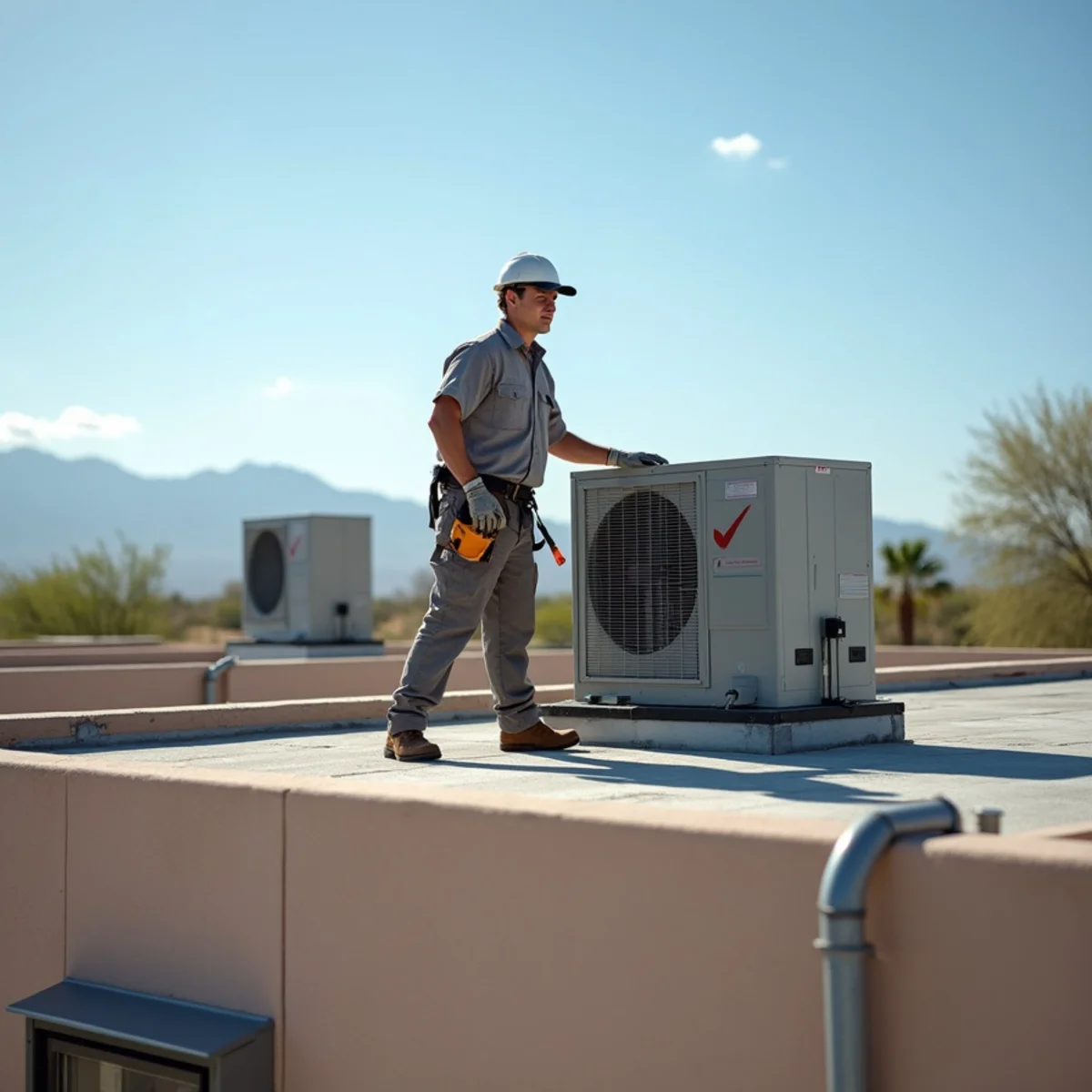
If you own or manage commercial space along Apache Trail or the US-60 Superstition Freeway frontage, your comfort system is almost certainly a bank of rooftop package units (RTUs) baking on a flat roof in 110-degree sun. When one quits during a July afternoon, a tenant's dining room, retail floor, or waiting room becomes unrentable within the hour. The economics of commercial HVAC in Apache Junction are not about the cost of a capacitor. They are about the cost of the hours your space cannot be used.
This guide is written for the people who sign the leases and the maintenance checks: property owners, on-site managers, and small-business operators from the Idaho Road interchange out to the Goldfield turnoff. We cover how RTUs fail in this climate, why a preventive maintenance contract pays for itself, how to schedule work around business hours, and how to keep an equipment failure from turning into a liability claim. Our commercial HVAC team in Apache Junction services this corridor daily, so the examples here are drawn from real desert rooftops, not a generic manual.
Why the US-60 Corridor Is Hard on Rooftop Units
Package units carry the entire cooling system, the compressor, condenser, evaporator, and blower, in one cabinet on the roof. That design is efficient for commercial buildings, but it also means every component sits fully exposed to the harshest conditions Pinal County can produce. Three local factors shorten RTU life along this corridor:
- Roof-surface heat. A flat commercial roof can hit 150 to 170 degrees in July. The unit is pulling its condenser air from that superheated layer, so head pressures run high and compressors work harder than the nameplate ever assumed.
- Monsoon dust and haboobs. Blowing dust off the desert and the SR-88 shoulder cakes condenser coils, chokes airflow, and packs into contactors. A coil that looks clean from the parking lot can be 40 percent blocked on the fin face.
- Traffic grime and delivery diesel. Frontage-road buildings collect a greasy film that dust sticks to, insulating the coil and accelerating corrosion on economizer linkages and drain pans.
The result is predictable. Neglected RTUs in this corridor tend to fail at the worst possible time, mid-afternoon on the hottest days, when the compressor is already at the edge of its envelope and one more stressor tips it over.
The Real Cost of Downtime
Owners underestimate downtime because they only count the repair invoice. The bigger number is the revenue and goodwill lost while the space is too hot to use. Here is a realistic picture for common corridor tenants during a summer outage.
| Tenant type | What a hot afternoon costs | Secondary risk |
|---|---|---|
| Restaurant / cafe | Cleared dining room, walk-outs, kitchen line at 95F | Food-safety holding temps, staff heat exposure |
| Retail storefront | Customers leave in minutes, no browse time | Refrigerated displays, inventory heat damage |
| Medical / dental office | Canceled appointments, rescheduling backlog | Patient comfort complaints, sterilization areas |
| Professional office | Staff sent home, productivity lost | Server-room overheating, equipment throttling |
Preventive Maintenance Contracts: What Actually Belongs in One
A preventive maintenance (PM) contract is the single most effective tool for keeping corridor tenants comfortable and keeping surprise failures off your calendar. But not every contract is worth signing. A meaningful commercial PM agreement for this climate should schedule at least two full visits a year, timed for the desert, and should document what was found. Look for these line items:
- Spring cool-down inspection (March to April): full coil cleaning, refrigerant charge verification, capacitor and contactor testing, belt and bearing check, condensate drain clearing before monsoon.
- Fall heat-changeover inspection (October): gas-heat or heat-pump reversing-valve check, safety controls, economizer damper operation, filter change ahead of winter.
- Coil cleaning that reaches the fin face, not a garden-hose rinse of the cabinet exterior.
- Amp-draw and pressure readings logged per unit, so a compressor trending toward failure is caught before it strands a tenant.
- Filter management on a documented schedule, since desert dust loads filters roughly twice as fast as a coastal climate.
A good contract also gives you priority dispatch. When 20 buildings lose cooling in the same heat wave, the customers with active PM agreements get served first. That is not a sales gimmick. It is how any honest commercial shop triages a triple-digit emergency day.
Scheduling Around Business Hours
The corridor never fully sleeps, but most tenants have a window when service is least disruptive. Restaurants prefer mid-morning before the lunch rush. Retail leans toward early morning before opening. Offices are easiest after close. Coordinated PM work is planned around those windows so a coil cleaning does not empty a dining room during peak covers.
For emergency repairs, that scheduling flexibility disappears, which is exactly why prevention matters. A planned 7 a.m. coil cleaning is a minor inconvenience. An unplanned 2 p.m. compressor failure in July is a crisis. The whole point of a PM program is to convert the second kind of event into the first.
Downtime, Liability, and the Duty to Keep Space Habitable
Commercial leases in Arizona generally obligate the landlord to keep leased space in usable condition, and cooling in this climate is not a luxury. When an RTU fails and stays failed, you can face rent abatement claims, tenant heat-exposure complaints, and, in worst cases, spoiled inventory or refrigeration losses that land back on the building. Documented preventive maintenance is your best defense: it shows a good-faith standard of care and dramatically lowers the odds of a failure in the first place.
This is where a local relationship beats a distant national contractor. Our base at 461 W Apache Trl is on the corridor itself, so response along US-60 is measured in minutes, not the hours a Phoenix-based crew loses fighting freeway traffic east. For the broader region we serve, see our Pinal County HVAC service overview, and for the deep dive on retail rooftop care, read our companion guide on rooftop package unit maintenance for East Valley retail.
A Practical Starting Point for Corridor Owners
If you have not had your rooftop units professionally serviced this year, start with a baseline inspection before the next heat spike. Get amp draws, pressures, and coil condition documented on every unit. From there, a two-visit PM contract keeps those numbers where they belong and keeps your tenants where they belong: inside, comfortable, and paying rent.
Frequently Asked Questions
At least two: a spring cool-down inspection before the heat arrives and a fall changeover before heating season. In the desert, coils and filters load faster than in milder climates, so some high-traffic tenants such as restaurants benefit from a mid-summer coil check as well. The spring visit is the one you never skip, because that is what carries the unit through July and August.
Yes. On a triple-digit heat-wave day when many buildings lose cooling at once, customers with active preventive maintenance agreements are dispatched first. Because our base is at 461 W Apache Trl right on the corridor, response times along Apache Trail and US-60 are typically much faster than a crew coming from central Phoenix.
For planned maintenance, yes. Coil cleanings, filter changes, and inspections are scheduled around your least-busy window, early morning before a retail store opens or mid-morning before a restaurant's lunch rush. Emergency repairs happen whenever the failure happens, which is exactly why we push preventive scheduling: planned work protects your peak hours.
No. A package unit houses the compressor, condenser, evaporator, and blower in one cabinet on the roof, which is standard for corridor storefronts and offices. A split system separates the outdoor condenser from an indoor air handler. Most commercial buildings along US-60 run package units, and they need rooftop-specific service because every component sits fully exposed to that 150-plus-degree roof surface.
Talk to a Local Apache Junction Technician
Same-day across Apache Junction & Gold Canyon — 24/7 in triple-digit heat.
Call +1 (327) 210-5999