
San Tan Valley & Queen Creek's Builder-Grade AC Cliff: What to Expect at Year 12
The subdivisions that exploded across San Tan Valley and Queen Creek in the mid-2000s were built fast with builder-grade ACs. Those units are now hitting a reliability cliff around year 12, and a wave of homeowners is facing the same decision at once.
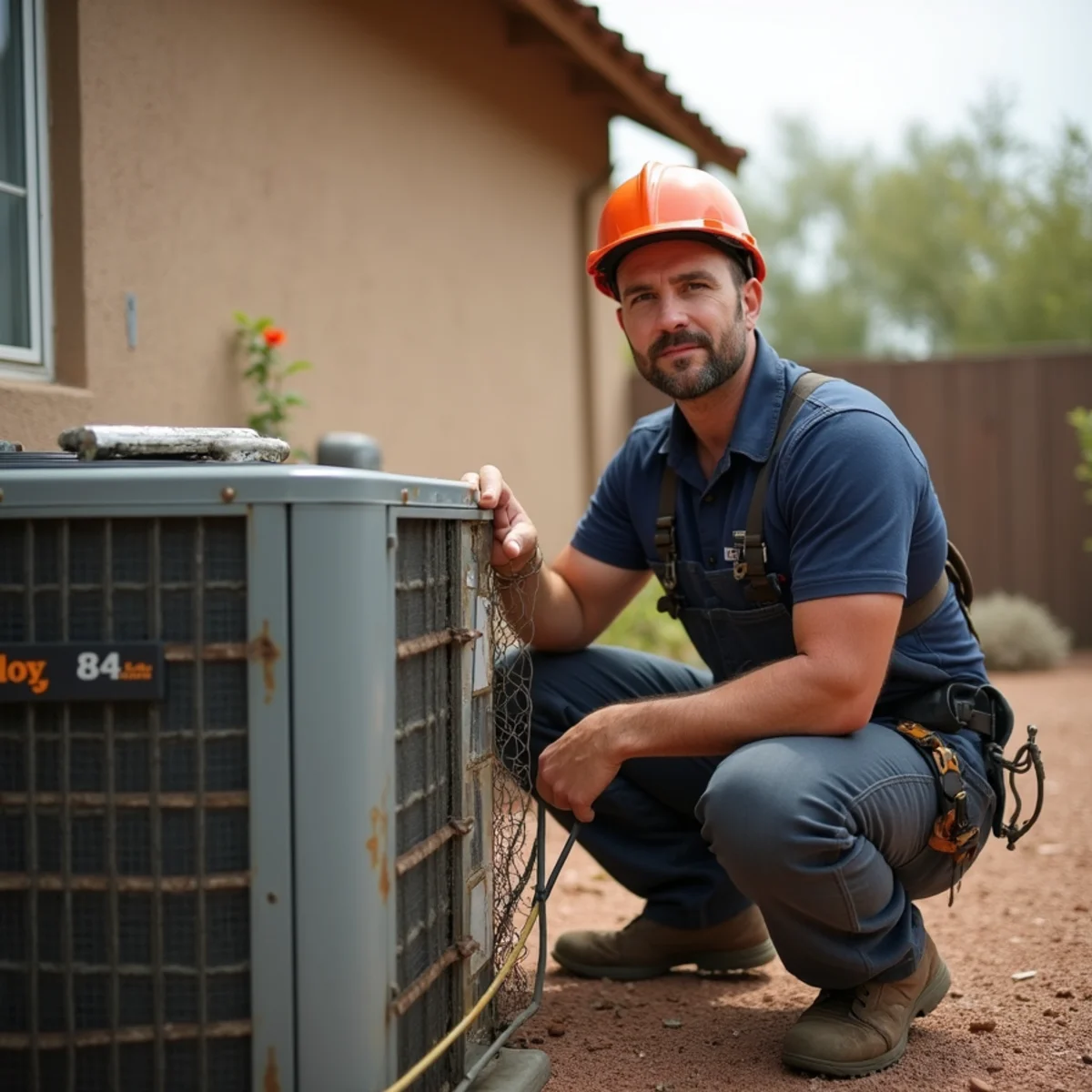
Anyone who watched the East Valley grow remembers how fast San Tan Valley and Queen Creek filled in. Between the early 2000s and the 2008 crash, subdivision after subdivision went up on the old farmland, built quickly to hit a price point. To hit that price, builders installed the most basic HVAC equipment that met code: builder-grade, single-stage, minimum-efficiency air conditioners. Those systems did their job. But nearly two decades of desert summers later, they are all reaching the end of the road at roughly the same time, and that is creating a predictable wave of failures.
If you own one of these homes, understanding the cliff ahead of you turns a July emergency into a planned decision you make on your own terms.
What Builder-Grade Actually Means
Builder-grade is not an insult, it is a market segment. To keep a new home affordable, the developer chooses the least expensive equipment that passes inspection. In practice that meant single-stage compressors, base-model coils, thinner cabinets, and the minimum SEER rating allowed at the time. There is nothing wrong with that equipment when it is new. The problem is that the cheapest components have the shortest desert lifespan, and they were never built to be babied.
The Year-12 Pattern
We see a recognizable sequence as these systems approach the cliff. It rarely fails all at once. It nickels-and-dimes you first, then makes the big ask:
- Years 8-10: the first capacitor or contactor fails, an easy, cheap repair.
- Years 10-12: refrigerant runs low from a slow leak, the unit needs recharging, and repairs start clustering.
- Year 12ish: a major component, usually the compressor or the outdoor coil, gives out, and the repair cost approaches a large fraction of a new system.
- The decision point: sink real money into a 12-year-old base-model unit, or replace it with something efficient that will last.
| System age | Typical issue | Smart move |
|---|---|---|
| 8-10 years | Capacitor / contactor | Repair |
| 10-12 years | Refrigerant leak, recharges | Repair but start planning |
| 12+ years | Compressor or coil failure | Usually replace |
| Any age, R-22 refrigerant | Obsolete refrigerant | Replace, do not sink money in |
The R-22 Wrinkle
Some of the oldest units in these neighborhoods still run on R-22 refrigerant, which has been phased out under EPA rules and is now scarce and expensive. If your system uses R-22 and springs a leak, recharging it can cost a small fortune for refrigerant alone, and you are pouring it into obsolete equipment. That situation almost always tips the math toward replacement rather than repair.
Repair or Replace: Making the Call
The honest rule of thumb: if a single repair on a system past 12 years costs more than a third of a new system, replacement is usually the better long-term value, especially given how much more efficient modern SEER2 equipment is than a mid-2000s builder-grade unit. A complete AC or heat-pump replacement in this market generally runs about 7,000 to 11,500 dollars installed, and a right-sized modern system can meaningfully cut summer power bills compared to the base unit it replaces. We size every replacement with a proper Manual J load calculation rather than just swapping the same tonnage, and our AC installation team handles these subdivision swaps constantly.
This is playing out all over San Tan Valley, and just as heavily in the neighboring Queen Creek subdivisions built in the same boom. Whole streets went up in the same two-year window, so whole streets are hitting the cliff together. For a full breakdown of what a new system actually costs across the East Valley, from Apache Junction to Mesa, see our guide on AC replacement cost in the East Valley.
Frequently Asked Questions
Often 10 to 14 years here, short of the 15-to-20-year national average. Builder-grade units use the least expensive single-stage components, and running at full load through six or seven months of triple-digit heat wears them out faster. Many mid-2000s San Tan Valley and Queen Creek homes are reaching that cliff now.
A good rule of thumb is that if a single repair on a system past 12 years costs more than about a third of a new system, replacement is usually the better long-term value, especially since modern SEER2 equipment is far more efficient. If the unit still uses R-22 refrigerant, replacement almost always wins.
Many San Tan Valley and Queen Creek subdivisions were built in a short window during the mid-2000s boom, all with similar builder-grade equipment installed the same year. Because they aged under the same desert conditions on the same clock, whole streets tend to hit the reliability cliff around the same time.
A complete AC or heat-pump replacement in this market generally runs about 7,000 to 11,500 dollars installed, depending on size, efficiency, and the specifics of the home. That is market context, not a quote. We size every replacement with a proper Manual J load calculation rather than just matching the old tonnage.
Talk to a Local Apache Junction Technician
Same-day across Apache Junction & Gold Canyon — 24/7 in triple-digit heat.
Call +1 (327) 210-5999